Michelle Cliff
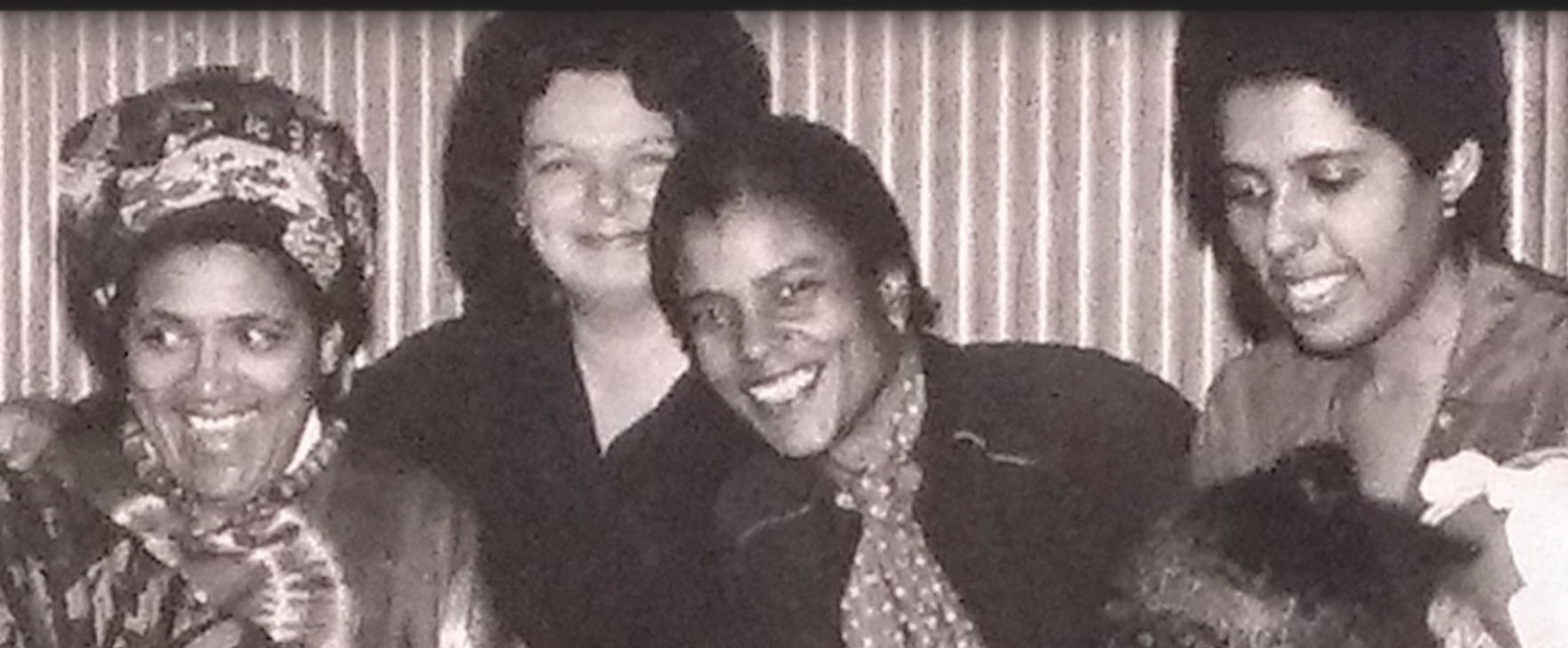
(Remarks from event at The New School honoring Michelle Cliff in 2017, organized by Honor Moore.)
For this occasion I said I would read from Into the Interior--in a letter when Michelle was revising it, she called it “my poor little novel (albeit naughty)”--which I read all one long good day when she sent it to me in manuscript, laughing a particular laughter that we need another word for in USA-English: the laughter that those who haven't yet died of the consequences of colonialism may share when describing its baffling lurid murderous almost unspeakable ways and means. Laughter that is both grieving witness and resistance, meeting the assignment of endless pointless sorrow with the rebellion of razorwit, of mockery, of laugh so hard your ribs ache, of an arched brow and a silence, of Not today, Satan. Laughter balanced on a dangerous edge, between tell it and die and tell it and live. Laughter that may tip into tears. Michelle was expert at provoking this laughter. And is expert, remains permanently expert, as you'll see when you read this book.
One of her Caribbean writer compañeros wrote about an aspect of the ethics of this kind of describing in his beautiful novel Texaco. In this section a daughter is remembering something her father told her--the 'békés' are the white slaveowners, and the 'poisoners' are the revolutionaries.
Later, to frighten poisoners, the békés invented the dungeon. I still see them here and there, on the land that remembers, and each time I shiver. Their stones have preserved sadnesses without a bottom, in gray. Those presumed guilty never came out, except maybe shackled at the feet, shackled at the neck, shackled at the soul, to furnish labor beyond all fatigue. Allow me not to describe the dungeon to you, Marie-Sophie, because you understand, my papa said, we must not illustrate those things, in order to leave to those who built them the full burden of their existence."
The first part of Into the Interior I'm going to read is a particularly good example of this laughter that describes without describing, about one of the narrator's early magazine assignments, to visit the man in the basement of the British Museum whose job it was to reassign the statue penises the Victorians had lopped off. A beloved colonial gesture, amputation, still. And someday when we've made a world beyond the pointless suicidal hypocritical viciousness of these arrangements, we'll have figured out a way to burn all these gestures and their centuries of vestiges to cook our food, to warm us all equally through the long cold free winters. But for now it's a waste disposal problem, one of many: what do we do with the traces of these centuries of colonial madness, reflecting fractal everywhere we look, including in the mirror?
One of Michelle Cliff's many answers: disperse them with this kind of laughter. Not to be confused with happy laughter, or careless laughter, or oblivious laughter, or forgetful or offhanded or individual laughter. The social laughter of, You can't take everything, You can't touch this.
“My last job had been for an American magazine, a research assignment that took me to the depths of the British Museum. Literally. The London bureau chief of the magazine took me to lunch to a restaurant called Inigo Jones and described my assignment. ‘You’re not going to believe this, but there’s a room in the basement of the British Museum that’s known as the penis room.’ ‘Really?’ I responded with the requisite surprise. ‘Yeah. Imagine. There’s one little guy down there who’s in charge of the whole thing. You know, wearing one of those blue jackets. It’s his job to match the cocks with the statues. Some kind of civil servant, huh?’ ‘And you want . . . ?’ ‘And we want you to research a short article for us about it; New York will put it together. You could start with some background. You know, the Victorians lopping off the cocks in the flrst place, bloody hypocrites. See what you can get on Lord Elgin. But we want you to keep it light. We’re going for laughs, you know. I’ll bet most people who see these statues think the things fell off from age or something, wear and tear. No such thing.’ Again: I needed the money badly; they paid extremely well.
I set out the next morning for the British Museum. With a temporary press pass secured from the magazine I gained entry. Underneath the Rosetta Stone I descended to the workrooms. There were doors to the right and left on a long corridor. Did those chambers harbor other bits of humanity? Breasts? I finally found it. The card on the door had a name, followed by Member Restoration. The man in the penis room opened the door a crack and asked me what it was I wanted. I gave him the name of the magazine and he brightened. I explained that I’d been sent to interview him about his job, and that the magazine would of course not treat his work as sensational in any way. He said he read the magazine whenever he could get a copy; he’d read it since the War when he was a boy and was very pleased indeed with its obvious regard for Churchill, who had been his hero. ‘Everyone’s hero actually, except for a few people — ingrates, really.’ Could he get a subscription in exchange for talking to me?
But of course. He let me in and offered me a chair. Through one wall came the sound of stitching. Someone mending the Domesday Book, he explained. ‘Sound travels down here, all right,’ he said. I looked around. There they were. Numbered in black paint. The table where he worked — trying to flgure out who went with whom, which was Hellenic, Hellenistic, Sumerian, Egyptian, Hittite, Roman, Byzantine — was in the middle of the room. All around him were his ‘chaps,’ as he called them. He held out the chap he was working on. ‘This here’s a particularly interesting chap,’ he said, ‘though one mustn’t play favorites.’ ‘How so?’ I took out my notebook. He propped the chap, carved from a dark stone — I’d guess obsidian — against the electric kettle on the worktable. ‘See how graceful he is? Note the way the foreskin curls. Sumerian, I think. But whose? That’s the question. A god? Or simply a lucky man?’
“How long have you been working on this?’ ‘Going on twenty years now.’ ‘Don’t you get lonely down here?’ ‘No time for that. The chaps are counting on me.’ ‘Tell me something?’ ‘Yes, miss?’ ‘Was it official policy to castrate the statues? I mean, is it written down somewhere? Or part of common law? Or was it the decision of some overzealous Lord Elgin taking matters into his own hands, as it were?’ ‘Couldn’t say, I’m sure. But we don’t like that term down here, do we.’ ‘I beg your pardon, but you must admit it’s a bit of an outrage.’ ‘What’s that?’ ‘To seize something perceived as a work of art, to perceive oneself as the conservator of beauty, and then to mutilate it.’ ‘Well, they were the Victorians, weren’t they.’ ‘And then to keep what they had hacked off.’ ‘In case there was a change of heart, I expect.’”
One last note on another weapon of dispersal: brujería, or spirit life, or as Jean Valentine memorably put it to me once, ‘woo woo,’ aka the value system of most of the human beings who've ever lived on this earth, before during and inshallah after this bloody so-called-Enlightenment chapter. A Dagara writer named Malidoma Patrice Somé says that in his language there's no word for 'supernatural'--the closest you can get is the word Yielbongura, which means 'the thing that knowledge can't eat.'
When I first met Michelle, in the house she and Adrienne shared, in the summer of 1994, she was thumping two bags of mulch on a table in their back yard, and telling Adrienne she'd bought roses, some beautiful kind of succulent roses she was unwrapping beside the dirt. I was writing a novel then and at some point talking about the details of the part where my Dutch settler carpenter ancestor was making doors on someone else's stolen land, in Caughnawaga, on the Mohawk River--and Michelle said, "Some of that is memory, kiddo." She gave me a copy of Free Enterprise, which I read later that week in one long sitting on a stolen bluff in stolen Mendocino, under a cedar, with an osprey wheeling around above me all day, trading whistles with another bird with three stripes on its head & an orange beak. More than once she told me the story about how on the day their beloved friend Arturo died, she asked him to send her a sign from the other side--and the next day a bird flew above her and dropped a piece of blue glass at her feet. So I'm keeping an eye out. Pasolini was a poet both she and Adrienne loved--he once wrote, "Death is not/in not being able to communicate/but in no longer being able to be understood."
I'm going to finish with the end of Into the Interior:
I wanted to find the island on the map that was not there.
So I followed her under the water. And this time she was not rescued to die of childbed fever, her daughter releasing her from the stone.
This time we were greeted by the mermaids of the unfathomable fathomable deep, those responsible for language. When I came to, I was washed ashore.
Apocalypso.